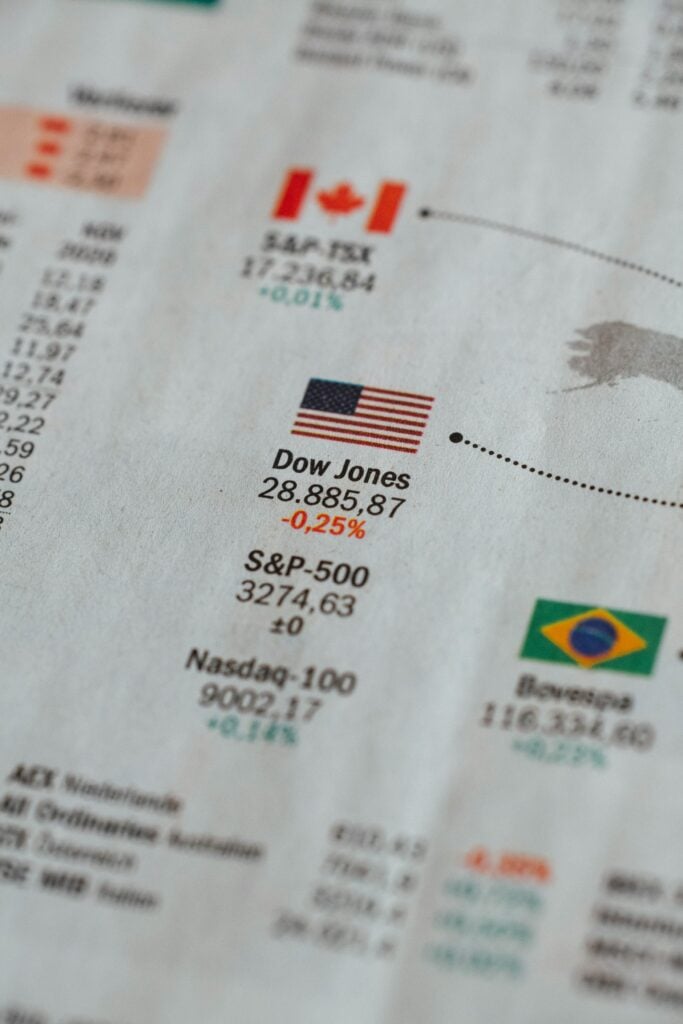
As of early 2026, the DJIA trades near 50,000 points, with a 52-week range from roughly 36,600 to 50,500, reflecting a strong multi-year bull trend.
Key facts
Constituents: 30 large-cap U.S. companies
Base year: 1896
Index type: Price-weighted average
Operator: S&P Dow Jones Indices
Recent level (Feb 2026): ≈ 50,100 points
Composition and methodology
The DJIA includes a cross-section of industries such as technology, healthcare, finance, and consumer goods. Components are selected by the The Wall Street Journal editors to represent the U.S. economic landscape. Unlike market-cap-weighted indexes, the DJIA assigns weight based on share price—so higher-priced stocks exert greater influence on movements.
Market role and significance
Often called “the Dow,” the index serves as a barometer for overall investor sentiment and U.S. economic health. It is widely cited in financial news to summarize market performance and is tracked by numerous funds and derivatives, including SPDR Dow Jones Industrial Average ETF Trust.
Recent performance
Through 2025, the DJIA advanced about 9–13 percent year-over-year, buoyed by strong corporate earnings and technology sector gains. Reaching the symbolic 50,000-point milestone in early 2026 underscored resilient market confidence despite higher interest rates and macroeconomic uncertainty.
Influence and use
The DJIA’s longevity and name recognition make it a cultural and financial touchstone. Investors, policymakers, and media use its daily fluctuations to gauge U.S. equity trends, while analysts note that it captures established corporate performance more than emerging-growth dynamics represented in broader indexes like the S&P 500.